
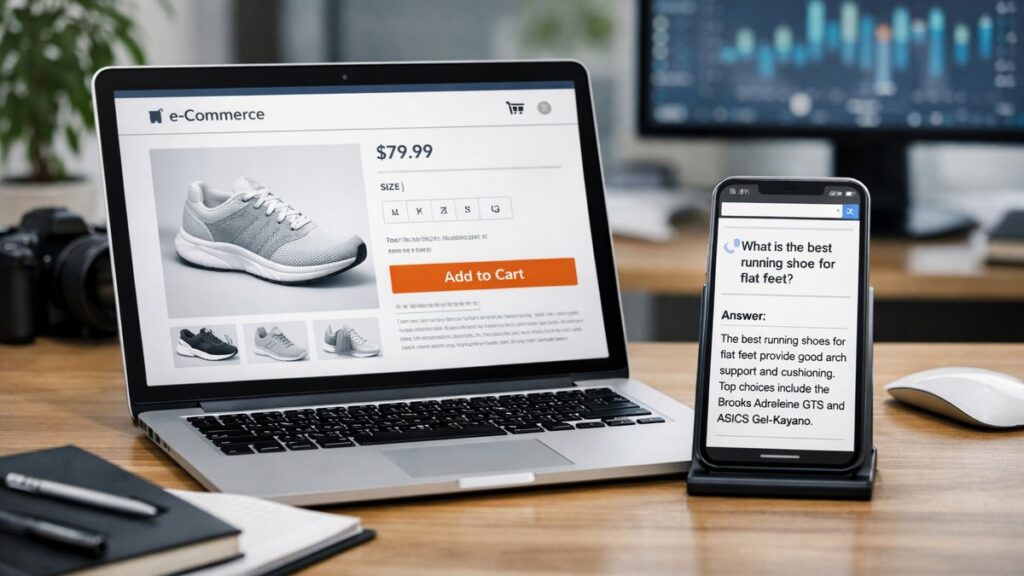
Why AEO for e-commerce demands a different approach
AEO for e-commerce is not simply about ranking higher — it’s about capturing the moment a buyer is ready to decide. When shoppers type questions like “best wireless headphones under $100” or “is this product compatible with X,” search engines increasingly serve direct answers pulled from product pages and category content. Brands that structure their e-commerce content for answer engine optimization appear in those results, cutting through the competition before a user ever scrolls. Understanding how AEO applies to product pages, buying guides, and review content is the foundation for turning organic traffic into qualified revenue. To see how this strategy fits within a broader framework, explore AEO across content types and industries.
Optimizing product pages for direct answer results
Key on-page elements that trigger answer results
Product pages must go beyond bullet-point specs. To qualify for featured snippets and AI-generated answers, each page needs clearly structured information that matches shopping-intent queries.
| Element | AEO best practice |
|---|---|
| Product title | Include primary keyword + defining attribute (material, size, use case) |
| Description opening | Answer the most common buyer question in the first two sentences |
| Specification block | Use structured lists, not dense paragraphs |
| FAQ section | Address compatibility, dimensions, warranty, return policy |
| Price & availability | Mark up with schema so engines can surface real-time data |
Price and availability markup
Search engines can display price ranges, stock status, and shipping details directly in results when pages implement Product schema correctly. The minimum recommended properties include:
- name — exact product name as it appears on the page
- offers — contains price, priceCurrency, and availability
- availability — use Schema.org values: InStock, OutOfStock, PreOrder
- priceValidUntil — keeps data fresh and trustworthy for crawlers
- shippingDetails — delivery time and cost, increasingly valued by answer engines
Structuring buying guides for AEO e-commerce success
Buying guides occupy a powerful position in the shopping journey: they answer comparative and evaluative questions that push users toward a final decision. Structuring them for AEO for e-commerce means anticipating those questions explicitly.
Buying guide structure that earns featured snippets
- Open with a concise summary paragraph that states the recommendation directly — search engines extract this as a direct answer.
- Use H3 subheadings for each product category or use case (e.g., “best option for professionals,” “best budget pick”).
- Include a comparison table with consistent columns: key specs, price tier, best for.
- Add a short FAQ block at the end targeting long-tail queries related to the buying decision.
- Implement HowTo or ItemList schema where applicable to signal content type to crawlers.
Review schema and its role in AEO for e-commerce
✅ What review schema enables
- Star ratings displayed in search results (rich results)
- Aggregate score surfaced as a direct data point
- Review count as a trust signal for answer engines
- Individual review snippets eligible for featured placement
- Enhanced visibility in comparison queries
⚠️ Common review schema mistakes
- Marking up reviews that are not visible on the page
- Using self-serving reviews without verified buyers
- Missing ratingValue and bestRating properties
- Applying AggregateRating without enough individual reviews
- Inconsistent schema between product variants
Product FAQ optimization: the core of e-commerce AEO
FAQ sections on product pages are among the highest-value AEO opportunities in e-commerce. They directly mirror the questions real buyers type into search engines. For a technical deep dive into implementation, consult the guide on FAQ schema implementation for e-commerce AEO.
How to build high-converting product FAQs
- Mine real buyer questions from customer support tickets, reviews, and “people also ask” boxes.
- Write answers that are self-contained — they must make sense without context from the surrounding page.
- Keep answers between 40 and 60 words: long enough to be useful, short enough to be extracted as a snippet.
- Cover objections, not just features: return policy, compatibility, safety certifications, sizing accuracy.
- Wrap every FAQ section in FAQPage schema using the Question and Answer types.
Category page AEO: turning browse intent into direct answers
Category pages are often neglected in AEO strategies, yet they attract high-volume queries at the consideration stage. Optimizing them for answer engine optimization requires layering editorial content on top of the product grid.
| Category page section | AEO purpose | Recommended schema |
|---|---|---|
| Introductory paragraph | Answer “what is this category” and “who is it for” | WebPage |
| Filter/facet explanation | Address “how to choose” queries | HowTo |
| Top picks list | Capture “best X” featured snippets | ItemList |
| FAQ block | Target long-tail and voice-search queries | FAQPage |
| Internal links to buying guides | Build topical authority and answer depth | — |
How Draftto generates e-commerce-ready AEO content
Producing AEO-optimized content at scale across thousands of product pages and categories is a significant operational challenge. Draftto addresses this by generating e-commerce content that is pre-structured for answer engine optimization from the first draft.
What Draftto automates for e-commerce AEO
- FAQ generation aligned to real buyer search queries
- Product description openings structured to answer the primary intent directly
- Buying guide frameworks with built-in comparison tables
- Schema-ready content blocks (FAQPage, Product, Review)
- Category page editorial copy optimized for featured snippets
The business impact
- Consistent AEO structure across the entire product catalog
- Faster time-to-publish for seasonal and new-product content
- Reduced dependency on manual SEO audits per page
- Higher eligibility rate for rich results and direct answer placements
- Content aligned to both human readers and answer engine crawlers
For e-commerce teams, AEO for e-commerce is the strategic layer that converts well-optimized product pages into answer engine assets. By combining product FAQ optimization, review schema, price and availability markup, and structured buying guides — and by using tools like Draftto to generate content that is already built for this purpose — online stores position themselves to capture shopping-intent queries at the exact moment a buyer is ready to act.