
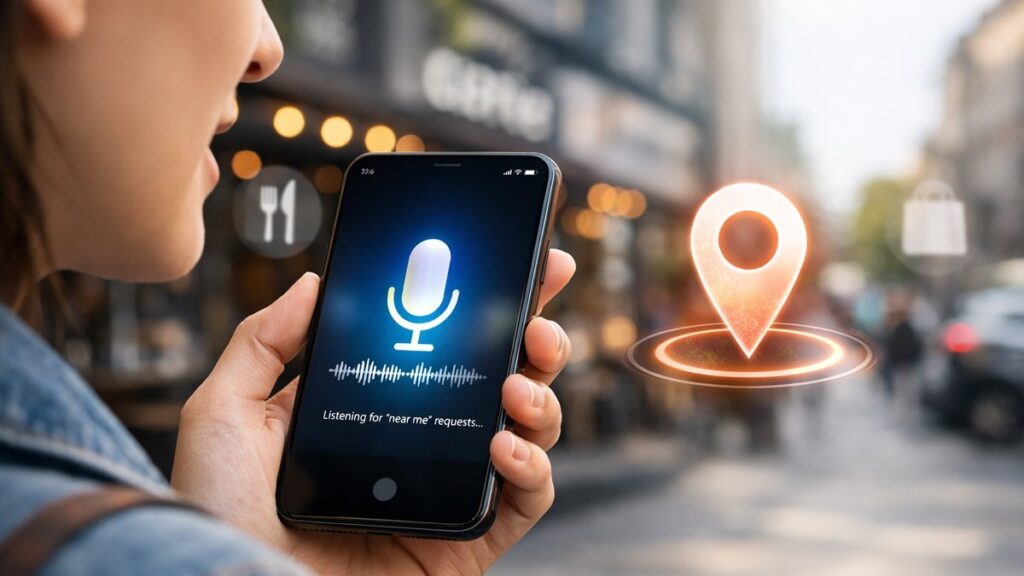
Why local voice search optimization changes how customers find you
When someone asks their phone “find a coffee shop near me” or “which plumber is open right now?”, they are using local voice search optimization in action — and your business either shows up or it doesn’t. Voice-driven “near me” queries have fundamentally shifted how local businesses need to structure their digital presence. Unlike typed searches, voice queries are conversational, intent-heavy, and demand instant, precise answers. Mastering local voice search optimization means aligning every layer of your online presence — from your Google Business Profile to your on-page content — with the way real people actually speak. For a deeper foundation on the broader discipline, explore voice search optimization strategies for AEO before diving into the local specifics below.
Optimizing your Google Business Profile for voice queries
Your Google Business Profile (GBP) is the single most important asset for local voice search. Voice assistants pull directly from GBP data to answer questions like “is [business name] open now?” or “what’s the phone number for [service] near me?”.
Essential GBP fields that voice assistants read
| GBP Field | Why it matters for voice search |
|---|---|
| Business name | Must exactly match your real-world signage and citations |
| Primary category | Determines which “near me” queries trigger your listing |
| Hours of operation | Powers “open now” voice results — keep them updated |
| Phone number | Directly spoken aloud by assistants in call-intent queries |
| Address | Used for proximity ranking and navigation requests |
| Q&A section | Pre-populate with conversational questions locals actually ask |
| Photos & services | Supports rich results and increases conversion after discovery |
Treat your GBP Q&A section as a mini voice-search FAQ. Write questions exactly as a person would speak them, then answer concisely in one or two sentences — this format mirrors what voice assistants prefer to read aloud.
NAP consistency: the silent ranking signal
NAP stands for Name, Address, Phone number. When these three data points appear inconsistently across directories, social profiles, and your own website, search engines lose confidence in your business’s legitimacy — and voice assistants are especially sensitive to this ambiguity because they can only return one answer.
NAP consistency checklist
- ✅ Verify that your business name is identical on Google, Yelp, Apple Maps, Bing Places, and your website footer
- ✅ Use the same address format everywhere — abbreviate “Street” or spell it out, but never mix both
- ✅ Keep a single primary phone number; avoid using tracking numbers as your main citation number
- ✅ Audit all directory listings at least twice a year — many update automatically and can introduce errors
- ✅ Remove or merge duplicate listings that fragment your authority
Local schema markup for near me voice search
Schema markup tells search engines exactly what your business is, where it operates, and what it offers — in machine-readable language. For local voice search, LocalBusiness schema is non-negotiable.
Key schema types for local businesses
🏪 LocalBusiness
Covers name, address, phone, opening hours, geo-coordinates, and price range. This is your baseline schema — every local page needs it.
⭐ Review / AggregateRating
Enables star ratings in voice results. Voice assistants often mention ratings when recommending local businesses in response to quality-based queries.
❓ FAQPage
Structures conversational Q&A content directly on your service pages, making it easy for voice assistants to extract spoken answers to hyper-local questions.
📍 GeoCoordinates
Embeds precise latitude and longitude data, improving proximity-based ranking accuracy for “near me” queries triggered without a typed location.
Hyper-local content that answers community-specific questions
Generic content does not win voice results. Voice search rewards specificity — content that answers the exact questions a local audience is asking. Hyper-local content bridges the gap between your business and the specific neighborhood, district, or community it serves.
Types of hyper-local content that drive voice discovery
- Service pages that name specific neighborhoods, landmarks, or local landmarks near your location
- Blog posts answering questions like “best [service] in [district]” using natural spoken language
- Local event coverage or community guides that build topical authority in your area
- Staff or team pages that reference local community involvement
- Pages that address local regulations, weather patterns, or seasonal needs relevant to your service
How Draftto helps generate locally-relevant AEO content
Creating hyper-local, voice-optimized content at scale is where most local businesses stall. Draftto solves this by generating AEO-optimized articles built around community-specific questions your target audience is already asking. Rather than producing generic service descriptions, Draftto structures content around the conversational query patterns that trigger voice results — complete with FAQPage schema suggestions, natural language phrasing, and answer-first formatting. The result is a library of locally-relevant articles that position your business as the authoritative answer for voice-driven “near me” searches in your area.
Structuring pages for voice search ranking: a practical guide
- Lead with the direct answer. Voice assistants read the first clear, concise answer they find. Put the most important information in the first sentence of every section.
- Use conversational H2 and H3 headings. Phrase headings as questions when appropriate — “Which [service] is available on weekends?” matches spoken query patterns.
- Keep sentences short. Aim for sentences under 20 words in answer paragraphs so they read naturally when spoken aloud.
- Embed FAQPage schema on service pages. Each FAQ item should mirror a realistic spoken question paired with a two-to-three sentence answer.
- Build internal links to your sub-pillar. Connecting local pages to your broader voice search content hub signals topical depth to search engines.
- Optimize page speed for mobile. The majority of voice queries happen on mobile devices — a slow page will not be selected as a voice result regardless of content quality.
Local voice search optimization: key factors at a glance
| Optimization area | Primary action | Impact on voice results |
|---|---|---|
| Google Business Profile | Complete and maintain all fields | High — primary data source for voice |
| NAP consistency | Audit and unify all citations | High — builds trust signals |
| Local schema | Implement LocalBusiness + FAQ schema | High — enables rich voice answers |
| Hyper-local content | Create community-specific Q&A pages | Medium-High — drives long-tail voice queries |
| Page speed | Optimize for mobile Core Web Vitals | Medium — threshold for voice result eligibility |
| Review management | Encourage and respond to reviews | Medium — influences recommendation queries |
Local voice search optimization is not a single tactic — it is a layered system where your Google Business Profile, NAP consistency, schema markup, and hyper-local content work together to make your business the answer voice assistants choose. Pair these fundamentals with a tool like Draftto to continuously generate locally-relevant AEO articles at scale, and you build a compounding advantage that keeps your business visible for every “near me” query your community sends.